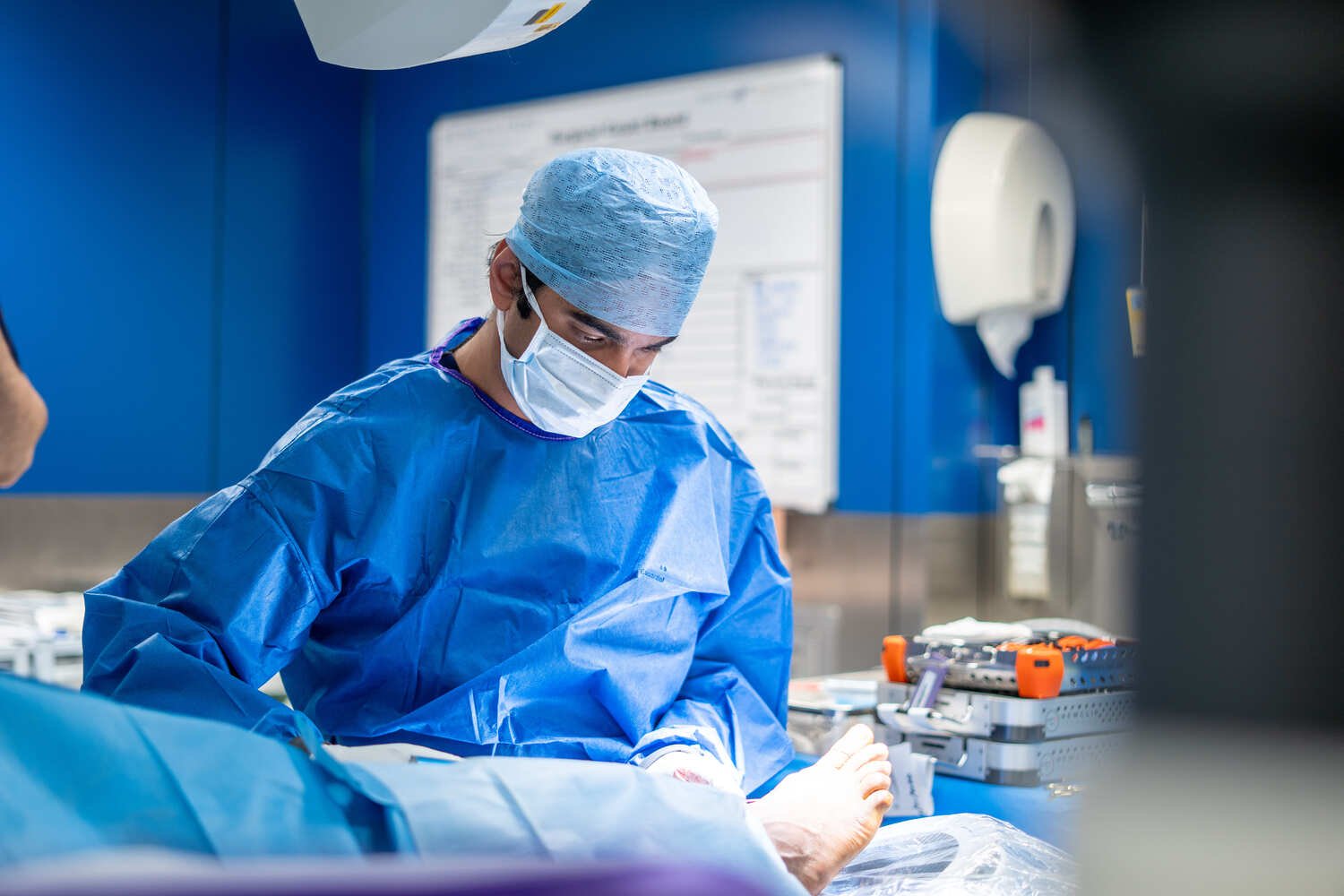
Rapid Bunion™ is Mr Kaser Nazir’s trademarked minimally invasive bunion correction protocol, and what sets it apart is not one single technical trick but the combination of precise keyhole surgical engineering with a complete, structured treatment pathway. The following questions address the specific technical, clinical and practical details patients most often want clarified before deciding whether the approach is right for them.
For a full comparison of how keyhole surgery differs from Scarf/Akin, Lapidus and other approaches, see Bunion Surgery Techniques Explained: Keyhole, Scarf/Akin, Lapidus & More.
The Basics
What is Rapid Bunion™?
Rapid Bunion™ is Mr Nazir’s signature minimally invasive keyhole bunion surgery technique, designed to correct bunion deformities through precision incisions and advanced fixation. Unlike traditional open bunion operations, which involve long scars, greater tissue trauma and extended recovery, this modern approach focuses on tiny incisions, minimal soft-tissue disruption, faster return to daily footwear and reduced pain and swelling. It also aims to deliver improved cosmetic and functional results compared with older open techniques. Mr Nazir developed the protocol by refining modern minimally invasive surgery (MIS) principles alongside advanced fixation methods across a large volume of bunion surgeries.
What makes Rapid Bunion™ different from other minimally invasive bunion techniques?
Rapid Bunion™ differs from many minimally invasive bunion procedures because it is not defined purely by surgical technique, but by an integrated treatment pathway built around the patient. Many minimally invasive approaches focus solely on the operation itself, whereas Rapid Bunion™ combines refined surgical engineering with structured planning and recovery support before and after surgery. Mr Nazir describes this as offering faster recovery and lasting correction compared with traditional methods. This distinction matters because a technically sound operation can still produce an inconsistent outcome if the surrounding care pathway is not equally well designed.
Is Rapid Bunion™ actually keyhole surgery, and what does that mean in practice?
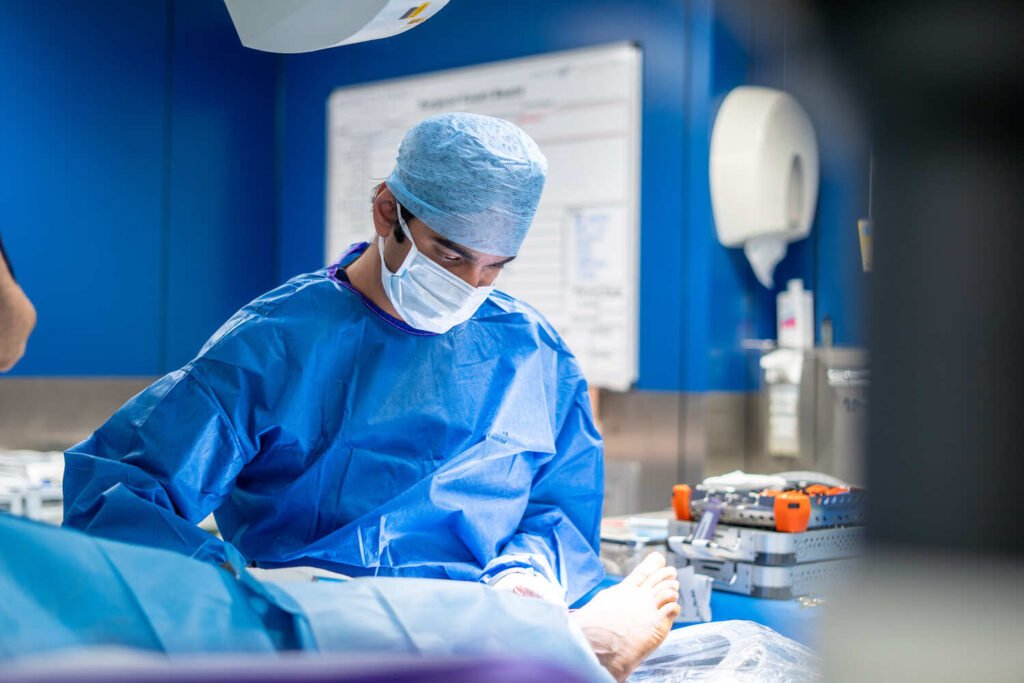
Yes. Rapid Bunion™ is performed through two to four puncture-sized incisions, each just a few millimetres wide, rather than the single long incision used in traditional open bunion surgery. This is what “keyhole surgery” and “minimally invasive surgery” refer to interchangeably: the bone is realigned and corrected through these small access points rather than through an open surgical field. Keeping the incisions this small preserves the surrounding tissue, reduces swelling, and keeps resulting scars almost invisible.
The Science Behind the Technique
Why do small incisions matter clinically, not just cosmetically?
Smaller incisions reduce the amount of soft-tissue disruption required to access and correct the bone, which is directly linked to less post-operative pain, less swelling, and a faster return to normal footwear. Traditional open bunion surgery, by contrast, typically leaves patients with long scars and limited mobility for weeks after the operation. The cosmetic benefit, near-invisible scarring, is therefore a visible sign of a deeper clinical advantage: less trauma to the tissue around the joint. This is why Mr Nazir frames the incision size as a functional feature of the technique rather than simply an aesthetic one.
What role does fixation play in the results Rapid Bunion™ achieves?
Rapid Bunion™ combines the small-incision approach with advanced fixation methods, the internal hardware and technique used to hold the corrected bone in its new position while it heals. Mr Nazir states that this combination is intended to support reliable long-term results, even in complex or revision cases, where a patient has had previous bunion surgery that has not fully corrected the deformity. Fixation quality is a key variable in how stable and durable a minimally invasive correction proves to be over time, which is why Mr Nazir treats it as inseparable from the incision technique itself.
Has the technique evolved, or is it a fixed procedure?
The technique has evolved. Mr Nazir notes that ongoing refinement now allows him to treat larger and more complex bunion deformities using keyhole techniques alone, cases that historically would have required open surgery. This evolution is presented as important for patients who want effective correction without unnecessary surgical trauma, since it widens the pool of patients who can benefit from a minimally invasive approach rather than being routed toward a more invasive open procedure.
Is Rapid Bunion™ only suitable for mild bunions?
No, this is a common misconception. Most patients with mild, moderate or severe bunions are suitable candidates for Rapid Bunion™. Suitable candidates typically include those experiencing pain when walking or standing, difficulty wearing regular shoes, cosmetic concerns about toe shape, second-toe crowding or early arthritis, and those with busy lifestyles who need a faster recovery. Severity alone does not rule a patient out, since Mr Nazir’s refinement of the technique has extended it to more complex deformities that previously required open surgery. A personal consultation with Mr Nazir is the way to confirm whether minimally invasive correction is appropriate for an individual case.
The Treatment Pathway
Is Rapid Bunion™ just the operation itself?
No. Mr Nazir describes Rapid Bunion™ as a complete treatment pathway rather than simply an operation. It integrates four elements: thorough pre-operative assessment and planning, a refined keyhole surgical technique, structured post-operative recovery protocols, and clear education, rehabilitation and expectation-setting for the patient. Mr Nazir states that this end-to-end approach is intended to support smoother, faster and more predictable recoveries for the majority of patients, rather than the surgical technique alone.
Why does pre-operative planning matter for a keyhole procedure?
Thorough pre-operative assessment and planning is one of the four core components of the Rapid Bunion™ pathway, alongside the surgical technique itself, structured recovery protocols and patient education. Careful planning before surgery allows the correction to be tailored to the individual patient’s deformity and goals, which supports the reliability of outcomes described elsewhere in Mr Nazir’s approach. This groundwork is treated as inseparable from the operation, not a separate administrative step.
What happens after the surgery itself, in terms of recovery support?
Structured post-operative recovery protocols form one of the four pillars of the Rapid Bunion™ pathway, alongside clear education, rehabilitation guidance and expectation-setting. Mr Nazir positions this structured support, rather than the incision technique alone, as central to why patients experience smoother and more predictable recoveries. Because the small-incision technique already reduces tissue trauma, pain and swelling, understanding the bunion surgery recovery timeline is essential for patients planning their return to activity.
Why does bunion surgery need a modern approach at all?
Bunions are one of the most common foot deformities, affecting one in four people under 65 and one in three people over 65. Traditional surgical methods have often left patients with long scars and weeks of limited mobility, a burden that scales with how common the condition is. Mr Nazir positions Rapid Bunion™ as a response to this gap, using refined surgical engineering to offer faster recovery and lasting correction for a condition that affects a substantial proportion of the population.
Deciding Whether It Is Right for You
How can a patient find out if they are a candidate for Rapid Bunion™?
Candidacy is confirmed through a personal consultation with Mr Nazir, during which the severity and characteristics of the bunion are assessed against the criteria that typically indicate suitability, including pain on walking or standing, footwear difficulty, cosmetic concerns, second-toe crowding, early arthritis, or a need for fast recovery due to a busy lifestyle. Because Rapid Bunion™ has been extended to more complex and revision cases through ongoing technique refinement, a consultation is the reliable way to establish suitability rather than assuming severity rules a patient out. Patients considering the procedure are invited to book a consultation with Mr Nazir to discuss whether Rapid Bunion™ is appropriate for their specific case.
What should a patient take away about what makes Rapid Bunion™ different?
The distinguishing factors are threefold: a true minimally invasive technique using two to four small puncture incisions; advanced fixation combined with refined MIS principles developed across a large volume of surgeries, supporting reliable results even in complex cases; and a complete treatment pathway spanning pre-operative planning, surgery, structured recovery and patient education, rather than the operation in isolation. Together, these elements form the basis for the smoother, faster and more predictable recoveries Mr Nazir aims to deliver for his patients.
To find out whether Rapid Bunion™ is the right approach for your bunion, book a consultation with Mr Nazir.