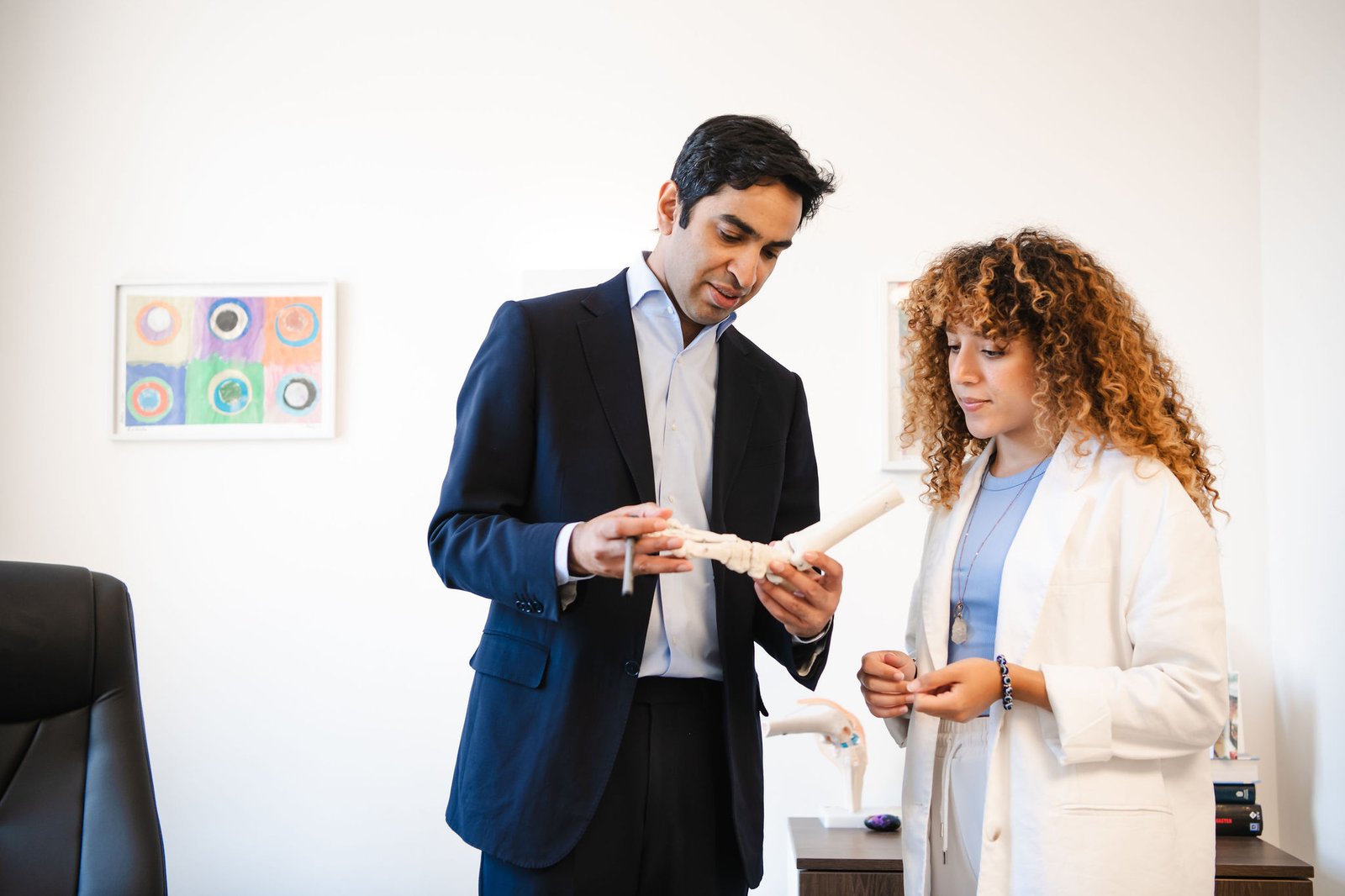
Claw toes and bunions can be corrected in the same operation in most cases. Mr Nazir routinely combines minimally invasive bunion correction with claw and hammertoe correction where both deformities are present, avoiding the need for two separate procedures. This article explains how the two conditions are connected, how combined surgery works, and what recovery looks like.
For a full breakdown of the surgical options available, see Bunion Surgeon’s guide to Bunion Surgery Techniques Explained: Keyhole, Scarf/Akin, Lapidus & More.
Understanding the Link Between Bunions and Claw Toes
Are bunions and claw toes actually related, or is that a coincidence?
They are anatomically linked, not coincidental. As a bunion progresses, the big toe pushes against the second and third toes, forcing them to buckle. Mr Nazir describes this as the big toe giving the second toe “an eviction notice.” Once the second toe buckles, continued bunion progression can cause the third toe to buckle too, leading to multiple toe deformities. Tighter footwear caused by the widening forefoot adds further crowding, compounding the problem. Claw toes can also occur independently, from genetic or muscular causes unrelated to bunions.
How common is it for bunion patients to also have claw toes?
Around a third of Mr Nazir’s bunion patients have a significant deformity of the second toe, and in half of those cases the third toe is affected as well. He commonly performs bunion correction alongside hammertoe correction of the second toe for this reason. Combined claw and hammertoe surgery alongside keyhole bunion surgery occurs in an estimated 20 to 25% of his cases.
What is the actual mechanism causing the toes to buckle?
An increased intermetatarsal angle (the angle between the foot’s long bones) creates transfer load and forefoot instability, which disrupts the balance of tendons and ligaments around the metatarsophalangeal joints, the knuckle joints at the base of the toes. This imbalance is what causes the lesser toes to claw. Patients who neglect an early bunion deformity, continue wearing tight footwear, or place ongoing stress on the forefoot are the typical profile Mr Nazir sees with both conditions present.
Combining the Surgeries
Can claw toes and bunions genuinely be fixed in one operation?
Yes. Mr Nazir has stated plainly that there is no need to have two surgeries: both deformities can be corrected at the same time. Keyhole bunion surgery and minimally invasive hammertoe correction are often carried out together for a more complete correction. The procedures and recovery pathways overlap significantly, which is why combined treatment is standard practice rather than the exception.
What happens if only the bunion is corrected and the claw toe is left untreated?
Leaving a claw toe uncorrected while fixing the bunion creates two problems: ongoing footwear fitting difficulties, and reduced stability holding the big toe in its corrected position. This reduced stability can raise the recurrence rate of the bunion itself. Patients may also continue to experience pain in the second metatarsophalangeal joint and the ball of the foot. For this reason, Mr Nazir advises addressing both deformities together whenever a claw toe co-exists with a bunion.
Is it a myth that claw toes need a completely separate referral and surgery?
Yes, this is a common misconception. Mr Nazir is direct on this point: claw toes and bunions are inevitably linked in most cases, even though claw toes can occasionally occur on their own for genetic or muscular reasons. Where a bunion has been left uncorrected for long enough, it typically starts to affect the lesser toes. Patients do not need two separate operations or two separate referral pathways when both conditions are present.
Are there other foot deformities that often appear alongside bunions?
Yes. The most common additional finding is subluxation (partial dislocation) of the second toe at the metatarsophalangeal joint, leading to a hammertoe deformity. Neuromas, thickened nerve tissue causing impingement in the spaces between the metatarsal bones, are another frequent finding. Occasionally, assessment also reveals issues with metatarsal length or general forefoot dysfunction contributing to metatarsalgia (pain in the ball of the foot).
Recovery After Combined Surgery
Does combining the surgeries make recovery longer or more painful?
Operation time is a little longer when treating multiple deformities, and early pain is somewhat greater. Patients may experience pain for a few extra days and may need slightly stronger pain relief for 48 to 72 hours. Beyond that window, recovery generally tracks the same pathway as bunion surgery alone, provided only one additional toe is corrected.
What does the walking and activity timeline look like after combined surgery?
Mr Nazir outlines a graduated return to activity: five to ten minutes of walking per hour for the first two days, increasing to ten minutes per hour between two days and two weeks, then fifteen to twenty minutes per hour between weeks two and four, with activity increasing gradually from there. If only one toe is corrected alongside the bunion, the overall recovery is very similar to bunion correction alone. Recovery takes somewhat longer only when multiple toes require correction.
Would Mr Nazir ever treat the two conditions as separate, staged surgeries?
Generally not, unless there is a specific clinical reason to do so. Staging may be considered if a patient has osteopenic bone (reduced bone density) or other comorbidities, particularly where multiple toes need correcting at the same time. Outside of these circumstances, Mr Nazir’s standard approach is to correct both deformities in a single procedure.
Is claw toe correction ever done purely for appearance, or is there always a functional reason?
Correction of toe length or shape is sometimes considered for better footwear fitting, but functional correction is assessed case by case. Where claw toe deformities are rigid and appear to be progressive, surgery may be a useful option even if the toe is not yet painful. This assessment is part of the same consultation and imaging process used to plan bunion correction.
Next Step
Patients who notice both a bunion and buckling of the second or third toe are encouraged to raise both concerns at the same consultation. Mr Nazir’s assessment will determine whether combined correction is appropriate, based on the degree of deformity, bone quality and any other findings from imaging. Book a consultation with Mr Nazir to discuss whether Rapid Bunion™ combined with claw toe correction is right for your feet.