By Mr Kaser Nazir, Consultant Podiatric Surgeon.
A bunion is not a growth of bone. It is a deviation: the big toe drifts towards the second toe while the first metatarsal bone (the long bone behind the big toe) shifts the other way, creating the visible prominence. The underlying cause is largely genetic, rooted in an inherited weakness in the big toe joint, while footwear such as high heels or tight, unsupportive shoes accelerates a problem that was already present.
For guidance on whether surgery is the right next step, along with non-surgical care options and the risks of leaving a bunion untreated, see Do You Need Bunion Surgery? Causes, Non-Surgical Care & Risks.
What Is a Bunion, Exactly?
What actually happens to the bone when a bunion forms?
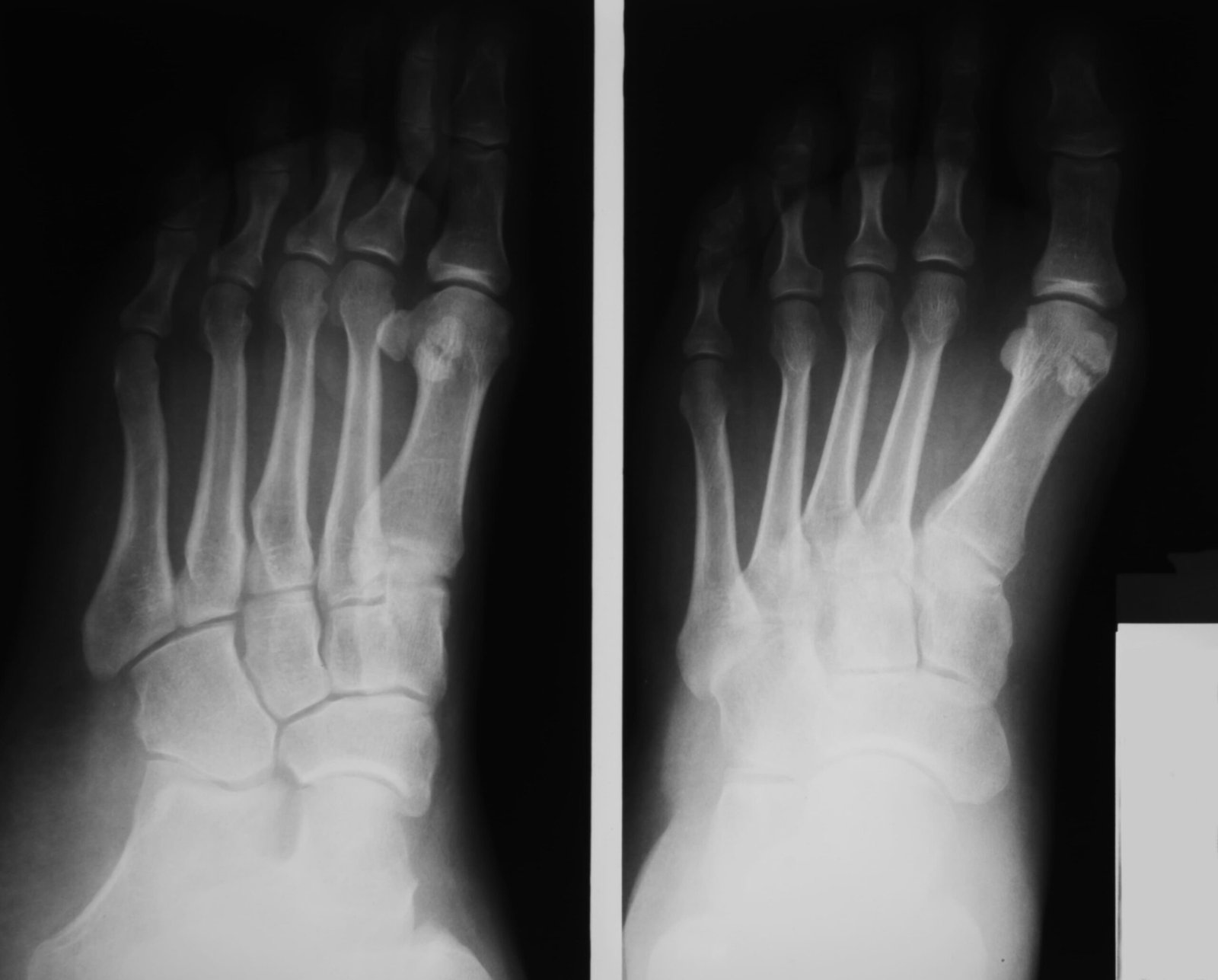
A bunion is a deformity of the big toe and the first metatarsal bone, the bone that sits just behind the big toe. Rather than new bone growing, the metatarsal bone protrudes towards the inside of the foot, forming a prominence, while the big toe itself pushes across towards the second toe. This combined movement, bone one way and toe the other, is what produces the characteristic bunion shape at the joint.
Is a bunion a bone growth on the side of the foot?
No. This is the most common misconception patients hold about their bunion. Most people assume the prominence is new bone forming on the inside of the foot, but it is in fact the existing metatarsal bone deviating outward while the big toe angles inward towards the second and third toes. Nothing is “growing”; the joint is realigning itself under mechanical stress, which is why correction focuses on repositioning the bone rather than removing a growth.
The Genetic and Evolutionary Basis
Are bunions mainly caused by genetics or by footwear?
Bunions are caused primarily by genetics, with footwear acting as an accelerating factor rather than the root cause. The mechanics involve a weakness in the first MTP joint (the joint where the big toe meets the first metatarsal bone), which makes the metatarsal unstable and causes it to deviate towards the inside of the foot, pushing the big toe towards the second toe. Poor footwear, particularly high heels or tight shoes worn for long periods, exacerbates this underlying instability and can bring pain forward sooner.
Why do bunions run in families?
Bunions are inherited, though not in a simple, predictable pattern: the condition does not necessarily show up in every generation and can skip one entirely. Mr Nazir notes that a patient’s grandparents may have had bunions even when the patient’s own parents did not, yet the deformity still counts as genetic. In practice, most patients presenting to Mr Nazir can identify a family history of bunions when asked to think back at least as far as their grandparents.
Is there an evolutionary explanation for why humans develop bunions?
There is a genuine evolutionary theory behind bunion formation. Humans have evolved so that the foot is used almost exclusively for walking rather than for grasping or picking things up, as it may once have been used. Some specialists view the resulting joint weakness as a legacy of this evolutionary shift, a structural vulnerability at the base of the big toe that footwear and daily loading can then expose over time.
Footwear’s Real Role
If genetics is the main cause, why do doctors still warn about high heels and tight shoes?
Because footwear does not create the underlying weakness, but it reliably makes an existing genetic predisposition worse. Mr Nazir observes that high heels are a common factor in his patients, and that unsupportive shoes such as ballerina flats, footwear with little structural support, often turn a previously silent bunion into a symptomatic, painful one. The joint instability has to be present first; footwear then determines how quickly and how painfully it progresses.
Can better shoes prevent a bunion from forming in the first place?
Footwear choices can reduce the mechanical pressure that speeds up bunion progression, but they cannot address the genetic joint instability that starts the process. This is why two people can wear identical shoes for decades with very different outcomes: the genetic predisposition, not the footwear alone, determines who develops a bunion.
Progression, Pain and When to Act
Can a bunion go away on its own or be reversed without surgery?
No. Bunions do not resolve on their own. Their progression can be slowed using measures such as insoles, but the deformity itself does not reverse without surgical correction. Surgery is currently the only solution for correcting the underlying bunion deformity itself, and minimally invasive techniques now allow this correction to be made through small incisions while reducing the risk of recurrence.
How is bunion pain different from arthritis in the big toe joint?
Bunion pain is typically felt only on the inside of the first metatarsal head, with normal range of motion when the big toe joint is moved passively during examination. Arthritis, by contrast, produces deep pain within the joint itself alongside ongoing stiffness. This distinction matters because the two conditions are managed differently, and an accurate diagnosis from a specialist avoids treating the wrong problem.
What other problems can an untreated bunion cause over time?
As a bunion progresses, the foot generally becomes wider and less stable, and related problems such as hammertoes (a bending deformity of the smaller toes) can develop alongside ongoing pain at the big toe joint. In severe, longstanding cases, ulceration can develop around the big toe and first metatarsal. Persistent footwear difficulty caused by the prominence is also a common presenting complaint.
Can children or teenagers develop bunions, and should they have surgery?
Bunions can appear in the very young, including children and preteens, though this is managed conservatively in that age group. Mr Nazir explains that the evidence supporting early surgical intervention before the growth plates have fused is poor, so even when a young patient will eventually need surgery, treatment is delayed until at least age 16. Parents concerned about a bunion appearing in a child or teenager should seek a specialist assessment rather than pursuing early surgical correction.
Getting an Accurate Diagnosis
How does a specialist confirm a bunion diagnosis versus another foot condition?
Diagnosis relies on clinical examination, assessing the location of pain, the range of motion in the joint, and the pattern of deviation of the big toe and metatarsal bone, to distinguish a bunion from conditions such as arthritis. Because bunion pain and arthritic pain in the same joint can feel similar to a patient but require different management, a specialist consultation is the reliable next step for anyone experiencing persistent big toe joint pain or a visible prominence.
What is the key takeaway for someone worried about why they developed a bunion?
Bunions form primarily because of an inherited weakness in the big toe joint, not because of any single footwear mistake, and the visible prominence is a deviation of existing bone rather than new bone growth. Footwear can accelerate progression and bring symptoms on sooner, but it is not the root cause. Anyone noticing early signs of a bunion, or concerned about a family history, can book a consultation with Mr Nazir to discuss an accurate diagnosis and the options available, including Rapid Bunion™, Mr Nazir’s trademarked minimally invasive bunion correction protocol.
Book a consultation with Mr Nazir at his Harley Street practice to get an accurate diagnosis and discuss the options available for your bunion, including whether Rapid Bunion™ is right for you.