A trademark on its own is not proof of clinical quality; it is a legal marker of ownership over a named protocol, nothing more. What matters is what sits behind the name: the training, the case volume, the structured pathway and the outcomes it consistently produces. This article explains what Rapid Bunion™, Mr Nazir’s trademarked minimally invasive bunion correction protocol, actually represents, so patients can judge it on evidence rather than branding.
For guidance on vetting a surgeon’s credentials and track record before booking, see Choosing the Right Bunion Surgeon in the UK.
What Does “Rapid Bunion™” Actually Refer To?
Is Rapid Bunion™ just a marketing name for standard keyhole surgery?
No. Rapid Bunion™ is Mr Nazir’s name for a specific minimally invasive keyhole technique combined with a defined treatment pathway around it. It is described as “not simply an operation” but “a complete treatment pathway,” integrating pre-operative assessment and planning, the keyhole surgical technique itself, structured post-operative recovery protocols, and patient education and expectation-setting. The trademark identifies this whole pathway, not just the incisions made during surgery. Patients researching the procedure should look at what happens before and after the operation, not only the technique used on the day.
What is the core technical difference between Rapid Bunion™ and traditional open surgery?
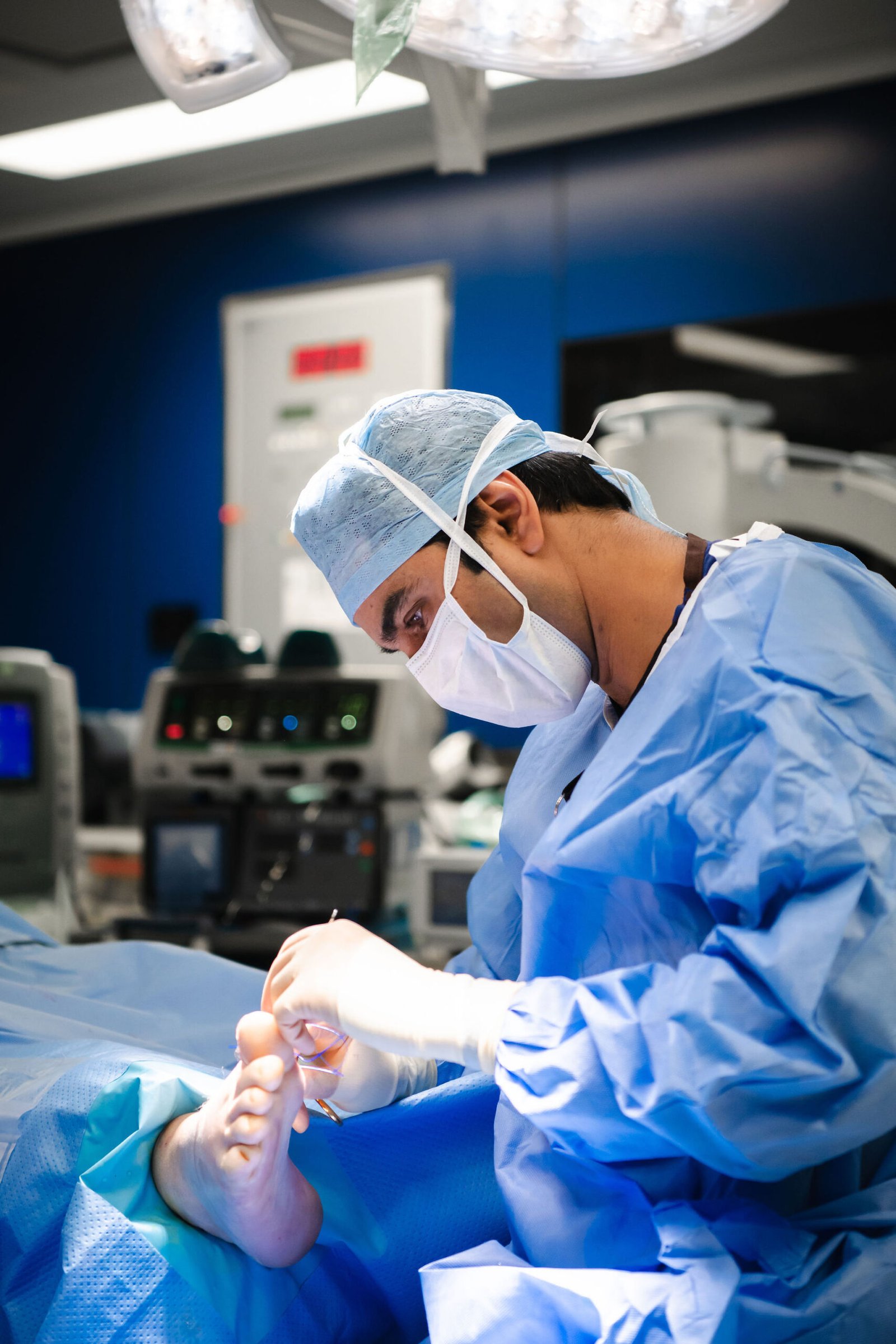
Rapid Bunion™ uses small incisions, described by Mr Nazir as “essentially stabs,” to access and correct the bone through a keyhole, or percutaneous, technique. Traditional open bunion surgery involves a full incision, dissection of the joint and surrounding bone, and more extensive soft tissue stripping. This distinction is the mechanical basis for the reduced tissue trauma, reduced scarring and faster recovery associated with the keyhole approach. Many patients ask whether minimally invasive bunion surgery is as effective as open surgery, and the answer lies in the precision of the correction despite the smaller access point.
Does a Trademark Signal Clinical Quality?
Does the ™ symbol mean the technique is clinically superior?
The trademark itself confirms only that the name and protocol are Mr Nazir’s own; it does not, by itself, prove superior outcomes. What supports the quality claim is the evidence behind the name: consistency of results from performing this one procedure repeatedly, and the structured pathway wrapped around the surgery. Patients should treat “trademarked” as a signpost to investigate the protocol behind it, not as a guarantee in itself.
Why does Mr Nazir focus on one procedure rather than running a general foot and ankle practice?
Mr Nazir has stated that focusing exclusively on bunion and foot reconstruction procedures using keyhole techniques allows for repeatability and consistency, which he considers central to reliable outcomes. He has observed that bunion surgery historically produced “mixed outcomes throughout the country” because of variability in technique, surgeon experience and post-operative care. Concentrating on a single procedure was, in his words, what allowed him to get “consistent, reproducible results,” which he describes as the reason he decided bunion surgery was his calling. This specialisation is the practical mechanism behind the Rapid Bunion™ name, not the name itself.
Is a named, trademarked protocol just a branding exercise, with no real clinical difference underneath?
This is a common misconception. The branding exists to identify a specific, repeatable pathway, not to disguise a generic procedure. The defining features are structural: tiny incisions and minimal soft-tissue disruption, faster return to daily footwear, reduced pain and swelling, and defined pre- and post-operative protocols. A patient evaluating any named surgical protocol, trademarked or not, should ask what specific steps distinguish it: technique, planning, rehabilitation, rather than accepting the name as sufficient evidence on its own.
How Should Patients Actually Judge Quality?
What should patients look at instead of the trademark itself?
Patients should look at the surgeon’s experience with this exact procedure, the consistency of outcomes across cases, and the structure of the pathway from assessment through rehabilitation. Mr Nazir has pointed out that specialisation, repeating the same procedure at volume, is what drives consistency, in contrast to general foot and ankle practices where a wider case mix can affect results.
How durable are the results from Rapid Bunion™ compared with other techniques?
Mr Nazir states that in 90 to 95% of bunions, the keyhole technique he performs, Rapid Bunion™, provides durable results with predictable outcomes. For patients with pre-existing arthritis in the first TMT joint (the joint at the base of the big toe) or pre-existing instability, a Lapidus fusion, a procedure that stabilises this joint, is indicated instead. On long-term durability, Mr Nazir is explicit that lifetime data does not yet exist because the technique is comparatively newer, though most bunion recurrences are seen within the first two years after surgery, and the absence of early recurrence in his cases supports confidence in longer-term stability. When considering which bunion surgery gives the best long-term results, patients must weigh the benefits of modern keyhole methods against traditional fusion techniques.
Should reviews be used to judge whether a technique or surgeon is high quality?
Reviews are useful but only if read carefully. Mr Nazir notes that independent reviews generally reflect genuine outcomes and feedback, but that feedback often relates to a clinic’s overall demeanour or experience rather than the specific procedure performed. He advises patients to seek reviews that refer directly to bunion surgery specifically, rather than general clinic feedback, when assessing a surgeon’s track record for this procedure.
Practical Next Steps
What is the honest takeaway on trademarked protocols like Rapid Bunion™?
A trademark is a naming device, not a clinical certification. The quality signal patients should actually rely on is what the name represents in practice: a defined keyhole technique, a structured pathway of assessment, surgery and rehabilitation, and a surgeon whose focus on one procedure is associated, in his own account, with consistent and reproducible outcomes. Any claim about specific complication rates, satisfaction percentages, or comparative outcome data beyond what is cited here should be confirmed directly with Mr Nazir before being treated as established fact.
What should a patient do next?
Patients considering keyhole bunion correction are encouraged to review the specifics of the Rapid Bunion™ pathway, assessment, technique and recovery protocol together, rather than the trademark alone. Book a consultation with Mr Nazir to discuss whether Rapid Bunion™ is appropriate for a particular bunion presentation, or find out more about booking an appointment.