By Mr Kaser Nazir, Consultant Podiatric Surgeon.
Keyhole (minimally invasive) bunion surgery corrects a bunion deformity through small incisions rather than one long surgical cut, using X-ray guidance to cut and reset the bone before securing it with screws. Mr Kaser Nazir, a Harley Street, NHS Consultant specialising exclusively in this procedure, performs the latest generation of this technique, known as Rapid Bunion™, his trademarked minimally invasive bunion correction protocol. This page answers the questions patients most often ask about how keyhole bunion surgery works, drawing on Mr Nazir’s own clinical experience.
Keyhole surgery is one of several established approaches to correcting a bunion, each with its own trade-offs in recovery time, scarring and long-term results; to see how Rapid Bunion™ compares with Scarf/Akin osteotomy, Lapidus fusion and other techniques, read Bunion Surgery Techniques Explained: Keyhole, Scarf/Akin, Lapidus & More.
The Basics
What is keyhole bunion surgery?
Keyhole bunion surgery, also called minimally invasive bunion surgery, corrects the bony deformity at the base of the big toe through incisions of around 3mm, rather than the longer open incision used in traditional bunion surgery. The surgeon works under continuous X-ray guidance, cutting the bone and resetting it into the corrected position without the wider soft-tissue disruption that open surgery requires. Mr Nazir performs the fourth-generation version of this technique, which he describes as “by far the latest and with the best evidence base, and it is the most advanced of keyhole bunion surgical techniques”.
How does keyhole surgery differ from traditional open bunion surgery?
Traditional open bunion surgery, such as the Scarf technique, involves a longer incision and causes more soft-tissue trauma as the surgeon works to access and realign the bone. This greater tissue disruption is associated with more post-operative pain and a longer healing period, because there is more tissue for the body to repair. Minimally invasive surgery avoids this by loosening the surrounding tissue and working through small incisions guided by X-ray imaging, which Mr Nazir notes results in less pain, quicker healing and the ability to bear weight immediately after surgery. Historically, bunion surgery has carried “a bad reputation” as one of the more painful orthopaedic operations, with high failure rates and prolonged recovery. These concerns drove the development of techniques designed to minimise post-operative pain and allow early mobilisation. Many patients often ask is minimally invasive bunion surgery as effective as open surgery when weighing these two different approaches.
Is keyhole bunion surgery a new or unproven technique?
No, this is a common misconception. Early (“generation one”) keyhole techniques did carry higher failure rates, and some surgeons still associate all minimally invasive bunion surgery with those early limitations. Mr Nazir is clear that the technique has evolved substantially since then: “generation four is almost a completely different procedure”. Some surgeons remain unfamiliar with the newer generations of the technique and therefore do not offer it to patients, which contributes to the misconception that keyhole surgery is inherently less reliable than open surgery.
How the Procedure Works
What actually happens during the procedure, step by step?
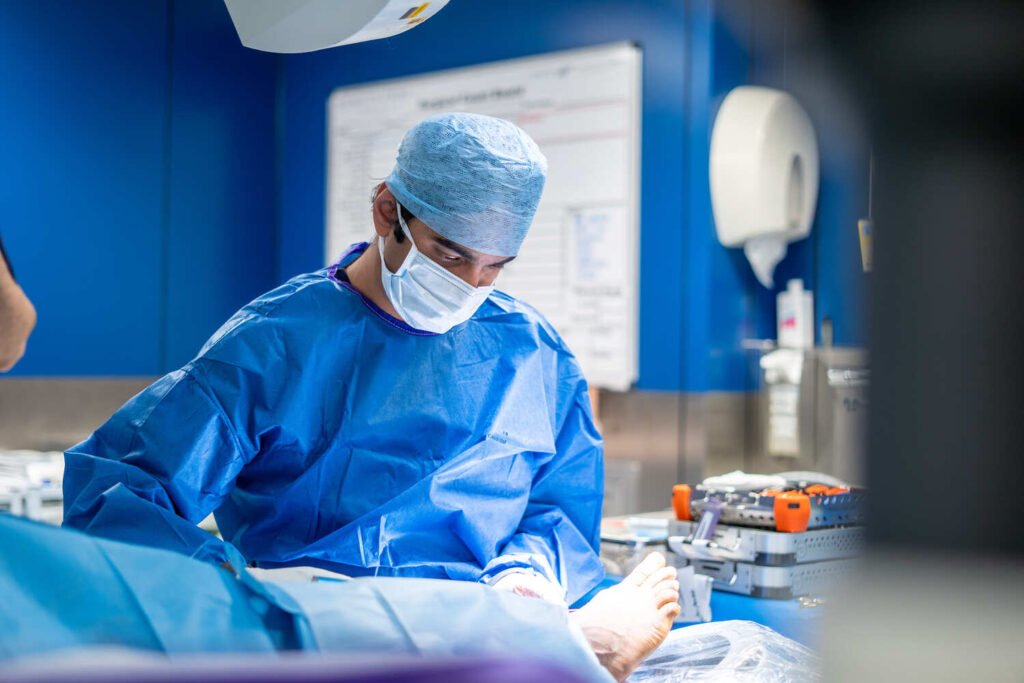
The surgeon positions the patient under live X-ray imaging, and every step, including cutting the bone, resetting it into the corrected position, and placing the fixation screws, is performed under continuous image guidance to ensure accuracy. This image-guided approach allows the deformity to be fully corrected in the correct position before the bone is secured. Mr Nazir has noted that the hardest technical part of the procedure is the accurate placement of the screws and wires, since this determines the stability, healing and full correction achieved.
Are screws or other hardware used, and are they left in permanently?
Yes. Rapid Bunion™, as a generation-four keyhole technique, uses screws designed specifically for this type of procedure to hold the corrected bone in a predictable position. These screws are typically left in the foot permanently and are designed not to irritate the skin or set off airport security scanners, though in a small number of cases removal may be needed if irritation occurs. The use of fixation screws is part of what allows patients to bear weight on the foot immediately, since the screws hold the corrected position even under the stresses of standing and walking.
How long does the surgery take?
The procedure typically takes between 30 and 40 minutes, though the exact time depends on the severity and complexity of the individual deformity. This is broadly consistent with Mr Nazir’s own account of operating time per foot.
Recovery and Mobility
Why does keyhole surgery allow same-day walking when open surgery often does not?
Same-day walking is possible because keyhole surgery avoids the extensive soft-tissue trauma associated with open techniques, meaning there is less tissue for the body to heal and less swelling-related complications. The rigid screws used in Rapid Bunion™ hold the corrected bone position securely even under the stress of early weight-bearing, which is what allows patients to mobilise sooner than they typically could after open surgery. Mr Nazir explains that “less pain and you are allowed immediate weight bearing” together make the overall recovery journey considerably easier for patients. Patients considering this should discuss their specific case with Mr Nazir directly, as individual recovery still depends on the severity of the deformity and bone quality.
Is the recovery from keyhole bunion surgery painful?
Open bunion surgery has historically been associated with significant post-operative pain due to the greater degree of surgical trauma involved. Minimally invasive techniques were developed specifically to address this, and Mr Nazir has described a 20-year ambition to produce a bunion operation that, in his words, “had a minimally painful post-op, allowed early mobilisation”. Because keyhole surgery involves smaller incisions and less soft-tissue disruption, it is associated with less post-operative pain than open techniques. To better understand the differences in patient outcomes, it is helpful to see how keyhole, Scarf/Akin, and Lapidus techniques compare.
What complications are associated with traditional open bunion surgery that keyhole surgery aims to reduce?
Open bunion surgery has been linked to a number of specific complications, including problems with the healing of hardware such as screws, bone failing to heal in the correct position, recurrence of the deformity, and difficulty achieving full correction across all planes of the deformity. Mr Nazir has noted that one of the main causes of recurrence after bunion surgery, regardless of technique, is applying the wrong procedure to the wrong patient, often due to undercorrection, a surgical error, or a failure of the fixation hardware during recovery. This is one reason Mr Nazir emphasises matching the specific surgical technique to each patient’s individual deformity and bone condition rather than applying a single approach to every case.
Suitability and Limitations
Is keyhole bunion surgery suitable for everyone with a bunion?
Not in every case. Mr Nazir uses minimally invasive surgery for the great majority of bunions but reserves open techniques, specifically the Lapidus procedure (a fusion of the joint at the base of the first metatarsal bone), for a smaller group of patients with instability at that joint or pre-existing arthritis there. He states that keyhole bunion surgery is not appropriate in cases involving arthritic changes to the big toe joint itself. For patients with these specific conditions, an open fusion procedure remains the more appropriate option regardless of how advanced minimally invasive techniques become.
Does the severity of the bunion affect which technique is used?
Mr Nazir notes that correction of the alignment through his usual technique should also improve function and reduce stress on the joint, so the approach does not necessarily change. In more moderate to severe cases, where there is underlying arthritis of the big toe (MTP) joint, there is a greater risk that a standard bunion correction could fail because of pre-existing arthritic changes in the joint, and these patients may instead need a procedure to remove the bony prominence, a joint fusion, or a joint replacement. This is why an individual assessment, including examination and imaging, is necessary before recommending a specific technique.
What role does footwear play in bunion development or worsening?
Footwear is a recognised contributing factor. Mr Nazir has observed that wearing high heels, ballerina flats, or other unsupportive shoes with little structural support is commonly associated with bunions becoming symptomatic. This does not mean footwear alone causes a bunion, but supportive footwear is often a sensible part of managing symptoms alongside considering surgical options.
What is the most durable long-term outcome for keyhole bunion surgery compared with fusion procedures?
In the majority of cases, which Mr Nazir estimates at 95% of bunions, minimally invasive bunion surgery, including his Rapid Bunion™ technique, provides durable results with what he describes as excellent and predictable outcomes. For patients with pre-existing arthritis in the first tarsometatarsal joint or pre-existing joint instability, a Lapidus fusion is indicated instead, as this group falls outside the population for whom keyhole correction offers the best long-term result.
Next Steps
Choosing the right bunion surgery starts with an individual assessment. Book a consultation with Mr Nazir to discuss whether Rapid Bunion™ is the right option for your bunion, and what recovery is likely to look like in your specific case.