Discharge from hospital after keyhole bunion surgery is not the end of active treatment, it is the start of a carefully staged recovery process. Most patients walk out of the clinic in a post-operative shoe on the same day as surgery, and what happens over the following 24 hours largely determines how comfortable the first week will be. This guide answers the questions patients most often ask about that first day at home.For a full week-by-week breakdown of what to expect after surgery, see Bunion Surgery Recovery: Timeline, Pain & Return to Activity.
The Basics: Getting Home and Getting Settled
Will I be able to walk out of the hospital?
Yes. Minimally invasive bunion surgery, including Mr Nazir’s trademarked Rapid Bunion™ protocol (a minimally invasive bunion correction technique performed through small incisions), allows most patients to walk immediately after the procedure in a post-operative shoe. This is a direct result of the smaller incisions and reduced soft tissue disruption compared with older open techniques, which historically required weeks of non-weight-bearing recovery. Patients should still arrange transport home, since the post-op shoe and any sedation used during surgery mean driving is not appropriate on day one.
What does my foot look like when I leave hospital?
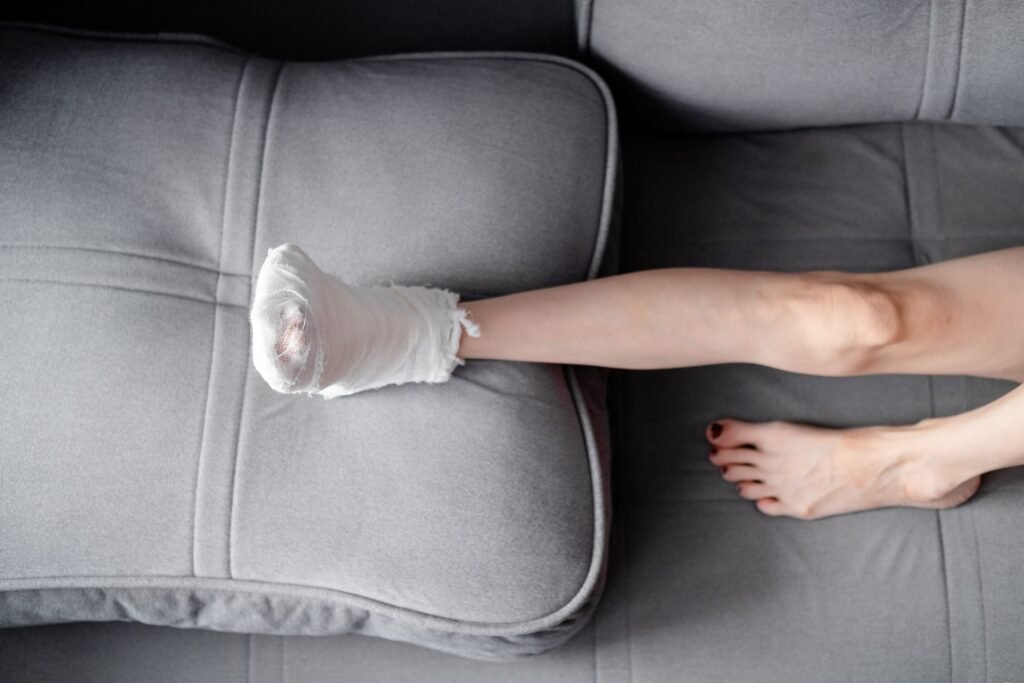
The operated foot will be bandaged in a bulky dressing designed to protect the wound and support the corrected bone position. This dressing stays on for the initial days following surgery and should not be removed or adjusted at home unless specifically instructed. A post-operative shoe with a rigid, flat sole is fitted before discharge, and crutches are provided for balance and confidence rather than because the foot cannot bear weight.
What type of anaesthesia will I have had, and how does that affect day one?
Keyhole bunion surgery is typically carried out as day case surgery under local anaesthesia or sedation, and the specific choice is discussed with Mr Nazir during consultation. An ankle block anaesthetic is commonly used, which keeps the foot numb through the early recovery period and softens the transition into normal sensation over the following hours. Patients should expect some return of sensation during day one, which is normal and part of the anaesthetic wearing off rather than a sign of complication.
Mobility on Day One
Can I actually walk on the day of surgery, or is that a myth?
It is not a myth: this is one of the most consistent features of modern minimally invasive technique. Patients can begin walking carefully from day one without the need for a cast, and are able to walk for around 10 minutes every hour immediately after surgery. This immediate weight-bearing capability contrasts with the older, more invasive procedures that required patients to stay off the foot entirely for weeks. The instruction to walk for short periods hourly, rather than staying static or overdoing activity, reflects the balance Mr Nazir’s team builds into the protocol between promoting circulation and protecting the healing bone.
Should I be resting instead of walking?
Both matter, and neither should be extreme. Patients are advised to rest with the leg elevated for the first two to four days following surgery, while still walking for short 10-minute periods each hour. Elevation is described as key during the first two weeks specifically because it controls swelling, which is the main driver of discomfort in early recovery. In practice, this means most of day one is spent resting on a sofa or bed with the foot raised above heart height, punctuated by brief, deliberate walks around the house.
How much pain should I expect on day one?
Most patients report only mild discomfort after minimally invasive bunion surgery, often needing no more than paracetamol after the first couple of days. Some patients notice mild to moderate discomfort and a throbbing sensation when the foot is lowered from an elevated position, along with increased swelling if they stand for extended periods. This is generally less than patients expect, largely because the technique causes less disruption to the surrounding soft tissue than older open procedures.
Common Misconceptions
Is it true that you cannot walk for weeks after bunion surgery?
This is a persistent misconception rooted in older surgical techniques rather than current practice. Modern minimally invasive methods, including Rapid Bunion™, allow immediate weight-bearing, and patients can begin walking carefully from day one without a cast. The idea of weeks of complete immobility applies to more invasive historical procedures, not the keyhole approach Mr Nazir performs. Patients should still expect a gradual build-up in activity over the following weeks rather than a return to full normal footwear on day one.
Practical Day One Questions
What painkillers will I need at home?
Most patients manage with paracetamol alone after the first couple of days, since discomfort tends to be mild rather than severe. Stronger painkillers are typically provided for the initial period covering the day of surgery, to be used as needed while the anaesthetic wears off and swelling begins to settle.
Do I need crutches even though I can walk?
Crutches are provided alongside the post-operative shoe, and a physiotherapist will guide patients through how to use both aids safely before discharge. Even though weight-bearing is permitted from day one, crutches help with balance and confidence while the foot is still numb or partially numb from the anaesthetic.
What if I am having both feet operated on at once?
Patients having bilateral (both feet) surgery should expect to spend considerably more time indoors during early recovery, since both feet are recovering simultaneously. For patients who find it difficult to stay housebound, Mr Nazir advises splitting the recovery: operating on one foot first while remaining mobile, then treating the second foot at a later date. This is a decision worth discussing directly during consultation, since lifestyle and work demands vary considerably between patients.
Why does one foot sometimes feel more sore than the other during recovery?
Patients undergoing bilateral surgery often notice that one foot feels more sore than the other during the healing stage. Mr Nazir explains this occurs because patients naturally favour one foot over the other while both are healing, shifting more weight onto the less painful side. This is a normal and expected part of bilateral recovery rather than a sign that one procedure went differently to the other.
When will I feel comfortable in a normal shoe again?
Some patients need several weeks before they feel comfortable transitioning into a trainer and resuming activities like commuting to work. This timeline varies by individual, and day one is only the very beginning of a staged process moving from the post-operative shoe, to supportive trainers, to normal footwear.
Next Step
Day one after keyhole bunion surgery is defined by careful elevation, short supervised walks, and manageable discomfort rather than the prolonged immobility associated with older techniques. Patients considering Rapid Bunion™ can book a consultation with Mr Nazir to discuss what recovery will look like for their specific case, including whether single-foot or bilateral surgery is the better option.