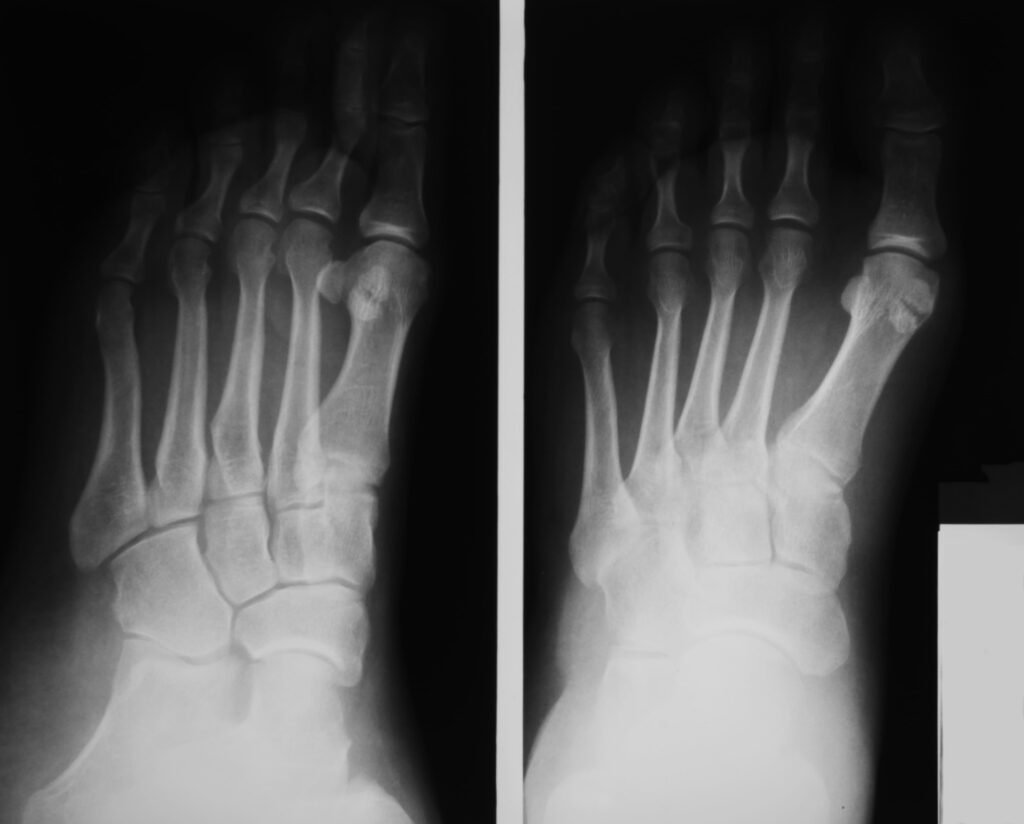

Bunion pain and arthritic joint pain can feel similar, but they have distinct clinical markers: bunion pain typically sits on the inside of the big toe joint with normal joint movement, while arthritis causes deep, stiff pain throughout the joint from cartilage wear. An X-ray usually confirms which is present, and in some cases both conditions exist together.
Patients unsure which applies to them, or wondering whether surgery is the right next step, can read Do You Need Bunion Surgery? Causes, Non-Surgical Care & Risks for a full breakdown of when treatment is necessary and what options exist before booking a consultation.
Understanding the Basic Difference
What is actually happening at the joint when someone has a bunion?
A bunion is not a growth of bone, contrary to common assumption. Mr Nazir describes it as the big toe becoming “essentially dislocated from the metatarsal at the ball of the foot,” where the toe falls off the end of the first metatarsal bone and angles towards the second and third toes. What looks like a bony lump on the inside of the foot is the head of the metatarsal becoming prominent as the toe drifts out of alignment, not new bone forming.
What is happening at the joint with arthritis?
Arthritis in the big toe joint involves wear of the joint cartilage, the smooth tissue that allows the bones to glide against each other. This produces deep joint pain and ongoing stiffness, which reflects damage to the joint surface itself rather than a positional problem.
What is the simplest way to tell a bunion apart from arthritis?
The clearest distinction is location and movement. Bunion pain is usually confined to the inside of the first metatarsal head, and passive examination, where the foot is moved by the examiner rather than the patient, shows normal range of motion in both extension and flexion. Arthritis, by contrast, produces deep pain within the joint itself and noticeable stiffness on movement, which points to cartilage wear rather than misalignment. Mr Nazir notes that on physical examination alone it is often possible to identify whether a bunion, arthritis, or a combination of both is present, though an X-ray is used to confirm this in most cases.
The Role of X-rays in Diagnosis
Why is an X-ray needed if the physical exam already suggests an answer?
A plain X-ray shows three things a physical exam cannot fully capture: the degree of deformity, the quality of the bone, and the quality of the joint cartilage. This combination helps confirm not just whether a bunion is present, but whether arthritic changes have also developed in the same joint, which then shapes the recommended treatment.
What specific measurements does Mr Nazir check on an X-ray?
Two angles are assessed. The intermetatarsal angle (IMA) measures the deviation between the first and second metatarsal bones and increases as a bunion progresses: a normal IMA is 7 to 9 degrees, a mild bunion runs up to 12 degrees, moderate is 12 to 16 degrees, severe is 16 to 20 degrees, and very severe is above 20 degrees. The hallux valgus angle (HVA) measures the position of the big toe relative to the first metatarsal, with a normal angle sitting at 10 to 15 degrees. These measurements give an objective severity classification that complements the physical exam findings.
Can an X-ray alone tell whether it’s a bunion, arthritis, or both?
In most cases, yes. Mr Nazir explains that a simple X-ray will determine whether a patient has a bunion, arthritis, or a mixture of the two. The imaging shows the bone position and angle measurements associated with a bunion, alongside any narrowing or irregularity of the joint space that signals cartilage wear consistent with arthritis. Occasionally, an MRI scan may be requested to evaluate cartilage and sesamoid bone health.
Can Bunions and Arthritis Occur Together?
Is it possible to have both conditions in the same joint at the same time?
Yes. Mr Nazir confirms that especially with long-standing bunion deformities, advanced arthritis can develop in the same joint over time. Among patients he sees with a bunion deformity, around 10% show evidence of mild to moderate arthritic changes in the big toe joint as well.
This is a common misconception: does having a bunion mean the pain must be arthritis, or vice versa?
No, and this confusion is common. Mr Nazir notes that some patients present believing they have a bunion problem when the underlying issue is arthritis, because they are not aware of the distinction between the two conditions. The reverse also happens, where stiffness is assumed to be arthritis when it is in fact linked to a misaligned joint. This is precisely why a physical exam paired with an X-ray, rather than symptoms alone, is used to reach an accurate diagnosis.
If both a bunion and arthritis are present, does that change the recommended treatment?
It depends on severity. For a bunion deformity with mild arthritic change, correcting the alignment can still improve joint function and reduce stress on the joint, so the surgical approach does not necessarily change. Mr Nazir assesses this on a patient-specific basis after reviewing the X-ray findings, since the degree of cartilage wear and bone quality shown on imaging informs what outcome can realistically be expected from realignment.
When to Seek a Consultation
Is bunion surgery only about the appearance of the joint, or does it address the underlying deformity?
The correction addresses the underlying misalignment, not just the visible prominence. Because a bunion is a positional deviation of the toe rather than a growth, realigning the bone is aimed at restoring normal joint mechanics, which can also reduce the mechanical stress that contributes to secondary problems such as hammertoes.
What happens if a bunion is left untreated for a long time?
Delaying treatment carries specific risks. Mr Nazir explains that leaving a bunion too long can allow secondary arthritic changes to develop, causing damage to the joint cartilage that may leave residual symptoms even if the bunion itself is later corrected. Long-standing bunions can also lead to hammertoes and chondrocalcinosis (calcium crystal deposits in the joint) as the shifting big toe crowds the second and third toes.
What are the warning signs that conservative treatment is no longer enough?
The threshold is patient-specific rather than a fixed rule. Surgical intervention becomes indicated once a patient is symptomatic, and particularly if forefoot deformity is developing, such as hammertoes or abrasions on the lesser toes caused by crowding in the foot. These signs suggest the deformity is actively progressing and affecting the rest of the foot, not just the big toe joint.
Is bunion development influenced by footwear, or is it mostly genetic?
Bunions are primarily genetic in origin. Mr Nazir notes that the tendency can skip a generation, meaning a patient may develop a bunion even if their parents did not, despite their grandparents having had one. Footwear can influence comfort and symptom progression, but the underlying deformity itself is inherited.
What is the earliest visible sign that a bunion is forming?
The earliest sign is a change in the direction of the big toe before any prominence appears. Mr Nazir identifies this as the toe beginning to point towards the second toe, which precedes the visible bony prominence most patients associate with a bunion.
What should someone do if they are unsure whether their foot pain warrants a specialist consultation?
A physical examination combined with an X-ray provides a definitive answer in most cases, and this assessment is best carried out by a podiatrist or doctor specialising in this area. Patients experiencing persistent pain around the big toe joint, widening of the forefoot, or the development of hammertoes should not wait for symptoms to worsen, since delayed treatment can allow secondary arthritic damage to set in. Booking a consultation with Mr Nazir allows for a clear diagnostic picture, physical exam findings alongside X-ray measurements of the intermetatarsal and hallux valgus angles, before any decision about treatment is made.
Key takeaways
-
Bunion pain is typically localised to the inside of the first metatarsal head with normal joint movement; arthritis causes deep, stiff pain from cartilage wear.
-
X-rays measure the intermetatarsal angle (normal: 7–9°, severe: 16–20°+) and hallux valgus angle to classify severity and detect arthritic change.
-
Around 10% of patients with a bunion deformity also show moderate arthritic changes in the same joint.
-
Delaying treatment risks secondary arthritis, hammertoes and chondrocalcinosis.
Patients uncertain whether their symptoms point to a bunion, arthritis, or both are encouraged to book a consultation with Mr Nazir for a physical examination and X-ray assessment.
Ready to find out what’s causing your foot pain?
A physical examination paired with an X-ray gives the clearest answer, whether that’s a bunion, arthritis, or both. Book a consultation with Mr Nazir to get a definitive diagnosis and discuss the right next step for your foot.