
To understand whether non-surgical treatments for bunion deformities work, it is important to understand the underlying cause of bunion deformities.
Historically, it has been well documented that bunions have a genetic predisposition. Approximately a quarter of the world’s population will suffer from bunions. A recent National Geographic article suggested that bunions could be linked to our evolution, in that as humans, we have started to use our feet differently.
When humans were primates and used their feet to perform tasks, the foot splayed so that the big toe could be used in a rotational grip format. This may be an evolutionary issue that persists today.
However, the debate is still ongoing, and we do know that poor footwear choices seem to speed up bunion deformity. Women seek treatment more than men, possibly due to footwear choices.
Can Non-Surgical Bunion Treatments Correct a Bunion?
Whether conservative treatments work depends very much on the underlying cause.
Since bunions are often genetic, one can certainly slow down the progression of bunion deformities, but cannot necessarily prevent them from progressing or occurring in the first place.
This is an important distinction for patients to understand.
Non-surgical treatments may help with symptoms, comfort and foot function, but they do not usually correct the structural bunion deformity once it has developed.
The Link Between Bunions and Flat Feet
There is an association between bunion deformities and flat feet.
If orthotics are used to stabilise the hindfoot, we do note that there is less rotational deformity of the first metatarsal. This makes the first metatarsal more stable and supports the joint.
In milder bunions, orthotics can alleviate the symptoms of bunion pain and should definitely be used as a first-line treatment alongside appropriate footwear.
This usually means shoes with:
- Plenty of room in the forefoot
- Good support around the hindfoot
- A structured design
- A rigid sole
- Enough space to accommodate the bunion bump
However, in later deformities, or in more moderate to severe bunion deformities where the deformity has already occurred and is more structural, orthotics have limited benefit.
Book a consultation today to understand your options and find out what treatment may be suitable for your bunion.
Do Orthotics Help Bunions?
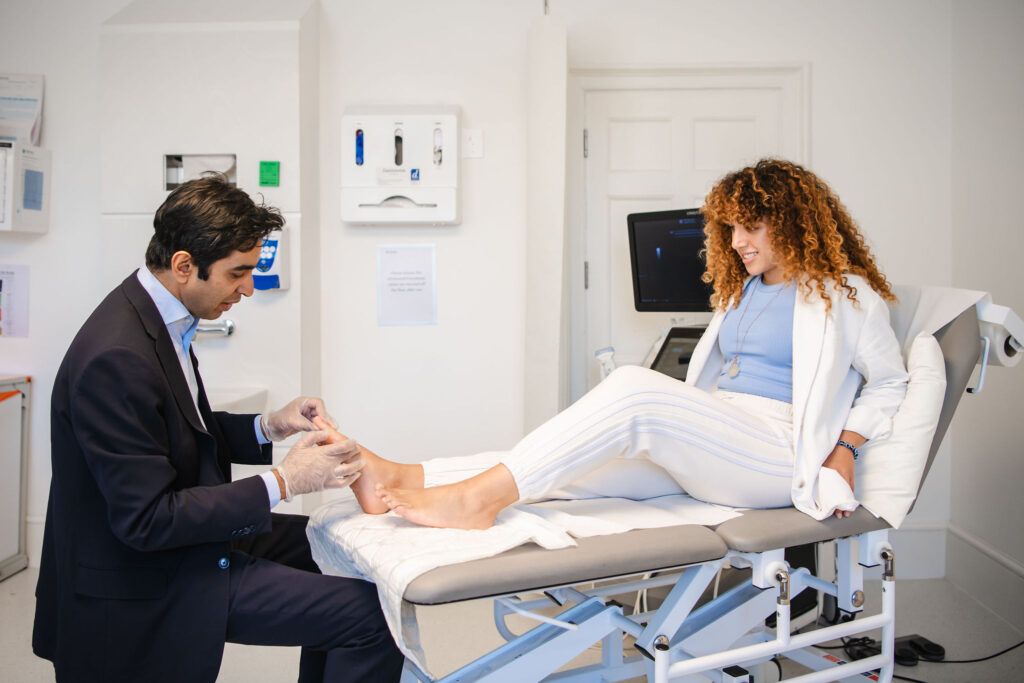
Orthotics may help in selected cases, particularly when the bunion is mild and there is associated flat foot posture or instability.
They can help by:
- Supporting the arch
- Stabilising the hindfoot
- Improving general foot mechanics
- Reducing pressure through the big toe joint
- Helping to alleviate bunion-related pain
However, orthotics will not remove the bunion or correct the underlying deformity once it has become established.
They are best thought of as a way to manage symptoms and support the foot, rather than a cure for bunions.
Use of Splints for Bunion Prevention or Treatment
Many patients come to clinic having used a variety of bunion splints over the years.
In my opinion, in most patients, these splints are trying to stretch out the lateral joint capsule and ligament. In more rigid and significant deformities, this can cause more pain and may actually cause ligamentous injury, worsening the pain around the joint itself.
Can Bunion Splints Help in Early Bunions?
Intrinsic foot exercises alongside the use of a splint in very early bunion deformity, or in children, have proven to be a little more successful, especially when used without shoes.
However, this is generally more relevant in very early, flexible deformities.
Once the bunion becomes more rigid or structural, splints are unlikely to correct the deformity and may irritate the joint further.
Do Toe Spacers Help Bunions?
Using a spacer between the big toe and second toe may seem logical, but it can sometimes cause further problems.
A toe spacer may push the second toe outwards and reduce the overall room available inside the shoe. This can increase pressure, rubbing and discomfort, particularly if the shoes are already narrow or tight.
Toe spacers may provide temporary comfort for some patients, but they should be used carefully and should not be expected to correct a structural bunion deformity.
Do Exercises Help Correct Bunion Deformities?
In very flexible feet, exercises can help stabilise the foot as a whole, especially when there is intrinsic foot weakness and the foot splays.
One can strengthen the arch and improve general foot stability.
However, the evidence is very limited, and if the deformity is significant, exercises are unlikely to help in the long term.
That said, intrinsic foot exercises have proven to help with general foot function and stability and should not be disregarded.
They may help with:
- Foot strength
- Arch support
- Balance
- Stability
- General foot function
- Symptom control in flexible feet
Exercises are unlikely to reverse a moderate or severe bunion, but they may still be useful as part of a broader conservative treatment plan.
Does the Right Footwear Make a Difference?
Yes. Footwear can make a significant difference in the non-surgical management of bunions.
If one uses shoes with plenty of space, allowing accommodation of the big toe and the bunion bump, and stabilises the arch with good hindfoot support and a good structured shoe with a rigid sole, this can help prevent pain.
The right footwear will not correct the deformity itself, but it can definitely assist in accommodating the foot better.
What Shoes Are Best for Bunions?
Patients with bunions should usually look for shoes that provide enough space and support without placing pressure on the bunion bump.
Good footwear features include:
- A wide toe box
- Soft or flexible upper materials
- Good hindfoot support
- A structured shoe design
- A rigid or supportive sole
- Enough depth to prevent rubbing
- Low or moderate heel height
- No tight pressure over the bunion
Poor footwear choices may speed up bunion symptoms and make the deformity more uncomfortable, especially if the shoes are narrow, stiff or high-heeled.
When Are Non-Surgical Bunion Treatments Most Useful?
Non-surgical bunion treatments are usually most useful when the deformity is mild, flexible or mainly causing intermittent symptoms.
They may help to:
- Reduce pain
- Improve comfort in shoes
- Support the arch
- Improve foot stability
- Reduce pressure around the big toe joint
- Slow symptom progression
- Delay the need for surgery in some patients
However, in moderate to severe bunions, or where the deformity is more structural, conservative treatments are less likely to provide long-term relief.
Can Non-Surgical Treatment Stop a Bunion Getting Worse?
Non-surgical treatment may help slow down progression in some cases, particularly when the bunion is mild and when poor footwear choices are contributing to symptoms.
However, because bunions often have a genetic predisposition, conservative treatment cannot always stop them from progressing.
This is why it is important to understand the goal of non-surgical treatment.
The goal is usually to:
- Reduce pain
- Improve function
- Improve footwear comfort
- Support the foot
- Manage symptoms
- Slow progression where possible
It is not usually to permanently correct the bunion deformity.

When Should You See a Bunion Specialist?
You should consider seeing a bunion specialist if:
- Your bunion pain is getting worse
- Shoes are becoming increasingly uncomfortable
- The bunion is affecting your walking
- You are struggling to find footwear that fits
- Splints or spacers are making the pain worse
- Orthotics are no longer helping
- The big toe is becoming more misaligned
- The second toe is being pushed out of position
- The bunion is affecting sport, work or daily life
A specialist assessment can help determine whether your bunion is mild and flexible, or whether it has become more structural and may require further treatment.
Do Non-Surgical Bunion Treatments Work?
Non-surgical bunion treatments can work for symptom control, especially in mild or flexible bunion deformities.
They may help reduce pain, support the foot and improve footwear comfort.
However, they do not usually correct the bunion deformity once it has become structural.
For more moderate to severe bunions, conservative treatments may have limited benefit, and surgery may be considered if symptoms continue to affect daily life.
Book a Bunion Consultation
If you are unsure whether non-surgical bunion treatments are right for you, or if you have tried orthotics, splints, spacers or footwear changes without lasting relief, it may be time to have your foot properly assessed.
Mr Kaser Nazir, Consultant Podiatric Surgeon, specialises in bunion assessment and minimally invasive bunion surgery.
A consultation can help determine whether your bunion can be managed conservatively or whether a more definitive treatment may be appropriate.
Book a consultation today to understand your options and find out what treatment may be suitable for your bunion.