
Correcting Overlapping Toes Without Open Surgery or Visible Scars
Many patients believe bunions only affect the big toe. In reality, a long-standing bunion deformity (hallux valgus) often disrupts the entire forefoot. Over time, this pressure can force the second and third toes out of alignment, causing them to lift, rotate and overlap neighbouring toes.
In this article, I explain how minimally invasive toe surgery, performed alongside keyhole bunion surgery, can correct overlapping toes effectively — with minimal scarring, faster recovery, and more natural cosmetic results compared with traditional open foot surgery.
How Bunions Lead to Overlapping Toes
A bunion is not an isolated deformity. As the big toe gradually drifts towards the lesser toes, it alters the mechanics of the forefoot.
In advanced cases, this results in:
- Sideways deviation of the second and third toes
- Lifting and rotation of the toes
- Crowding and overlap onto adjacent toes (often the fourth toe)
Over time, this creates both functional problems and cosmetic concerns.
The Two Biggest Problems Patients Experience
1. Pain and Difficulty Wearing Shoes
As the toes overlap and rub, even wide or soft footwear can become uncomfortable. Many patients struggle with:
- Pressure pain
- Skin irritation
- Inability to wear trainers or everyday shoes comfortably
2. Loss of Confidence in Open Footwear
Overlapping toes are often described as “unsightly” or “embarrassing”, particularly in sandals or open shoes. This cosmetic impact is real and should not be underestimated.
Why Traditional Open Toe Surgery Is Often Sub-Optimal
Historically, overlapping toes were corrected using open forefoot surgery, which may involve:
- Large incisions
- Joint fusion or pinning
- Tendon releases
- External wires (K-wires)
While sometimes effective, open surgery frequently results in:
- Visible scarring
- Prolonged swelling
- Toe stiffness
- Longer recovery periods
- Pins protruding from the toes
- Increased risk of scar-related pain
Even after extensive surgery, cosmetic results can still appear unnatural.
A Modern Approach: Keyhole Bunion Surgery + Minimally Invasive Toe Surgery
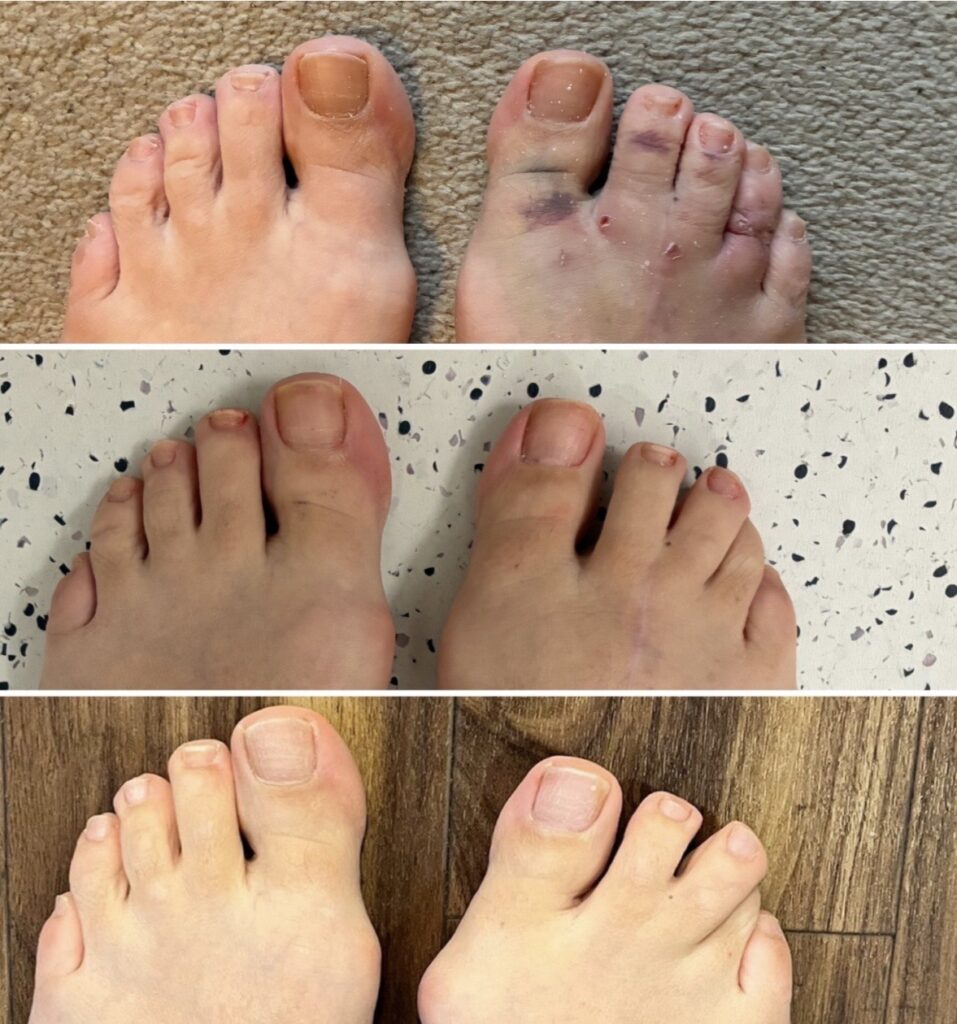
In this case, I performed a keyhole bunion correction combined with minimally invasive toe surgery for the lesser toes.
The before-and-after images (taken only weeks apart) demonstrate:
- Rapid improvement in toe alignment
- Restoration of a natural toe cascade
- Minimal swelling
- Excellent cosmetic outcome with virtually no visible scarring
What Is Minimally Invasive Toe Surgery?
Minimally invasive toe surgery (MIS) corrects toe deformities through tiny incisions (often ~2mm) rather than open cuts.
Using specialised instruments and a high-precision surgical burr, I can:
- Reshape bone
- Correct rotation and deviation
- Release deforming forces
- Realign the toes into a natural position
Key Benefits of Minimally Invasive Toe Surgery
- Minimal soft-tissue trauma
- Virtually no visible scarring
- Less post-operative stiffness
- Faster mobilisation
- Reduced pain and swelling
How Overlapping Toes Are Corrected Without Open Incisions
Overlapping toes result from bone malalignment, not just soft-tissue tightness. Effective correction must address the bone itself.
With minimally invasive techniques, I can:
✅ Precisely cut and reposition the bone
✅ Correct rotation and sideways deviation
✅ Restore alignment without extensive dissection
✅ Maintain toe mobility during healing
The goal is to restore:
- Comfort in footwear
- Improved function
- A natural appearance
- Confidence in wearing sandals again
No Wires or Pins Sticking Out of the Toes
One major advantage of minimally invasive toe surgery is avoiding external pins.
Traditional surgery often requires:
- K-wires protruding from the toes
- Weeks of pin care
- Higher infection risk
- Increased patient anxiety
With my technique, correction is maintained using:
- Structured taping
- Specialist bandaging
- Protective dressings
This stabilises the toes while healing occurs — without external hardware.
Recovery: You Remain Mobile
Despite correcting multiple deformities, patients are often surprised by how mobile they remain.
- Immediate weight-bearing in a protective post-operative shoe
- No prolonged immobilisation
- Bone healing typically occurs over 6–8 weeks
- Swelling gradually settles as alignment continues to refine
Patients can remain active within sensible limits throughout recovery.
Why I Prefer Minimally Invasive Toe Surgery
In my practice, minimally invasive forefoot surgery represents the future of bunion and toe correction.
It consistently delivers:
- Superior cosmetic results
- Minimal scarring
- Reduced stiffness
- Faster recovery than open surgery
- Natural toe alignment and spacing
When combined with keyhole bunion surgery, it allows comprehensive correction of the entire forefoot — not just the bunion.
Specialist in Keyhole Bunion & Minimally Invasive Toe Surgery
Mr Kaser Nazir
Consultant Podiatric Surgeon
I specialise exclusively in:
- Keyhole bunion surgery
- Minimally invasive toe surgery
- Complex forefoot deformity correction, including overlapping toes
I am internationally recognised for minimally invasive techniques and perform one of the highest volumes of keyhole bunion and toe surgery in the UK.
When to Seek Assessment
You may benefit from minimally invasive surgery if you suffer from:
- Bunions
- Overlapping or deviated toes
- Difficulty wearing shoes
- Cosmetic concerns about toe appearance
Early assessment often leads to more predictable correction and smoother recovery.
Book a Consultation
📍 Clinic location: 17 Harley Street, London
🩺 Consultations: Self-pay and insured patients
✅ No GP referral required (including Bupa)
If you are concerned about bunions or overlapping toes, a minimally invasive approach may provide the most advanced and effective solution available today.